Gender and Accountability Endline Report

The Gender and Accountability Project Cohort (G & A – C) is focused on strengthening the voice of women and mobilizing them against corruption and lack accountability in Nigeria. It has drawn out and amplified the nexus between corruption and women’s weak access to public services and facilities. The impact of corruption as exposed by this nexus necessitates the overarching goal of this project which is to mobilize the voices of women and girls to institutionalize anticorruption practices and accountability in Nigeria.

[wpdm_package id=’9020′]

Impact Assessment Of COVID-19 Pandemic On Women By WRAPA

The COVID 19 pandemic lockdown measures put in place to curb the spread of the coronavirus, brought about a lot of barriers with far-reaching impacts on the well-being of women and girls, particularly. This group face multiple challenges, deprivations and limitations in accessing social services or support in crises, and the outbreak of the COVID19 pandemic, as well as the public health measures by the governments at all levels, exacerbated the impact of the challenges already faced by women and adolescent girls among other vulnerable groups in the society. These impacts include mental health, loss of jobs and income, as well as the increase in sexual and gender-based violence (SGBV).

[wpdm_package id=’9019′]

Baseline Report – Haki Mkononi Project in Kaduna and Plateau States

The Haki Mkononi is a 2 year legal empowerment programme focused on working at a regional level with the African Union, its organs, Regional Economic Communities (RECs) and women’s rights organisations in 6 priority countries. It is aimed at ensuring that continental norms and standards translate to concrete gains for women and girls at the national levels through the domestication of the African Women’s Protocol and or passage of integral laws, their implementation and enforcement. In Nigeria, it is implemented by Women’s Rights Advancement and Protection Alternative (WRAPA) in Kaduna and Plateau States, with the overall goal of increasing and amplifying the demand for the domestication of the Women’s Protocol using the instruments of the GEO Bill and the VAPP Act in these States.

[wpdm_package id=’8790′]

WRAPA urges more women to engage in technology to advance women’s participation in future elections

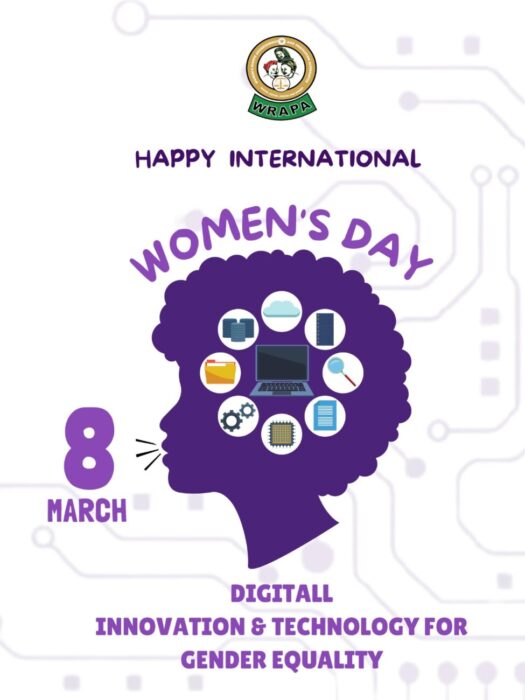
As we may know every March 8 is set aside as International Women’s Day. A day specially dedicated to celebrating women and their achievements around the world as well as raising awareness on the challenges being faced by women and determining ways of achieving gender equality.

This year’s celebration is themed “DigitALL: Innovation and technology for gender equality,” which highlights the role of innovative technology in promoting gender equality and meeting the health and developmental needs of women and girls, especially politics in the Nigerian context.

Gender inequality and discrimination in Nigeria affects women’s participation in elections as we’ve witnessed over the years, either as a voter or candidate, women frequently face social, physical, psychological, economic, and cultural obstacles that hinder the full exercise of their participation rights and they often suffer from discrimination and violence.

As at date, the number of females that won the Senate is 3 and the number that won the House of Representatives is 14 as opposed to 8 and 11 in the 2019 general elections respectively, while we secured gains in the House of Representatives the number of female Senators is relatively low.

Women encounter bias in politics which legitimizes the dominance of men. The political environment is hostile to women, negatively impacting their potential, retention, and progress. This is quite unsettling!

Notwithstanding, we cannot ignore the impact of the digital world and how it affects women globally. WRAPA Nigeria stands in solidarity with numerous CSOs, CBOs, and WROs who have dedicated this year’s International Women’s Day to achieving gender equality in the context of digitalization.

Women are more likely to improve their political participation through the great use of the digital world. We have witnessed how powerful the digital world can be in promoting advocacy for a just cause and one of them being women’s participation in politics. Therefore we are encouraging women to learn and relearn the usage of technology, adopting all its professional ethics to promote women’s participation in future elections.

Quite a number of women participated to be elected in the 2023 General Elections, but only a few knew who and what political platform they campaigned under and the reason for their lack of popularity in the political space is that the digital platforms available to popularize them were not properly or even used.

Today, WRAPA Nigeria calls on all institutions and people, especially women to break the digital gap within the shortest time possible with concerted efforts and voices to embrace the digital world and adopt its safe practices, innovation, and technology for gender equality.

We hope that by the next elections, there will be a significant number of women elected into political offices. Until then, let’s go DigitALL!

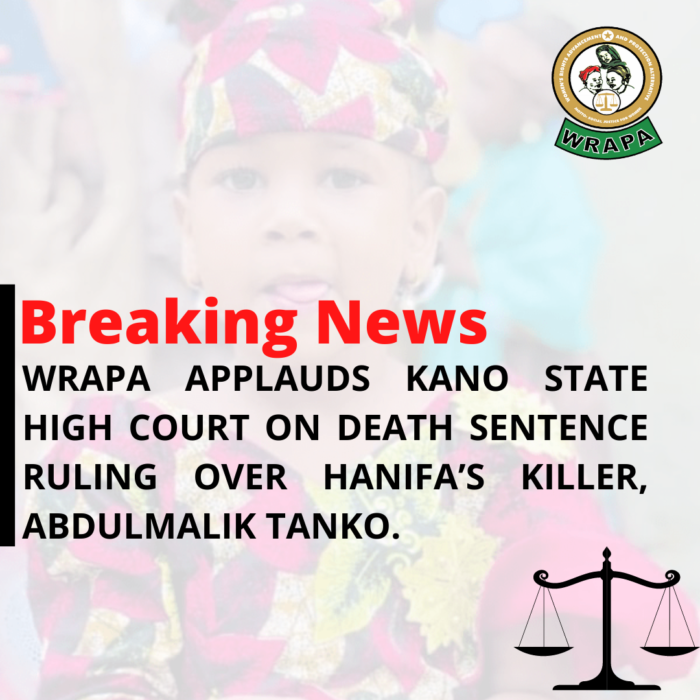
WRAPA applauds Kano State High Court on death sentence ruling over Hanifa’s killer, Abdulmalik Tanko

The Kano State High Court on Thursday sentenced the proprietor of Nobel Kids Academy and North West Preparatory School, Abdulmalik Tanko, to death for the kidnap and killing of five-year-old schoolgirl, Hanifa Abubakar.

The Presiding Judge, Justice Usman Na’abba, also sentenced Tanko to five years imprisonment for the four-count charges levelled against him.

Hanifa was a pupil of Noble Kids Comprehensive College; a school located in Kwanar ‘Yan Gana in Tudun Murtala Quarters in Nassarawa Local Government Area of the state.
She was abducted by Mr Tanko who demanded ransom from her parents and was reported to have killed her in December last year.

The judgement is a soothing ice on Women & Girls across the country. The recent rise on Violence Against Women & Girls with little or slow persecution has become alarming & infuriating to Nigerian women. We heartily commend the judgement of the Kano State High Court for the sentence duly accrued to the culprit and his accomplices.

While we applaud the judiciary system, we are equally hopeful that his Excellency, Kano State Governor, Abdullahi Ganduje, who had earlier this year vowed to sign the death sentence without further delay if given by the court will do as he has vowed.

WRAPA will continue to condemn all forms of Violation Against Women & Girls.
WRAPA condoles with the family of Hanifa who was a promising young girl full of life and never deserved any harm, let alone murder!

WRAPA will keep to its mandate on promoting Social Justice for Women and see that perpetrators of such hideous crimes are brought to book.

JUSTICE FOR ONE IS JUSTICE FOR ALL!

The War on Women’s Bodies Ends Now


A global estimate shows that about one third of women and girls ages 15-49 will experience physical and/or sexual violence in their lifetime.

Although some progress have been made to protect women and girls from human rights violations, particularly from SGBV, however West Africa is still a long way from providing truly violence-free societies for women and girls, with high records of SGBV incidences, child marriage, female genital mutilation, unsafe abortion, harmful practices and very poor access to sexual and reproductive health rights.

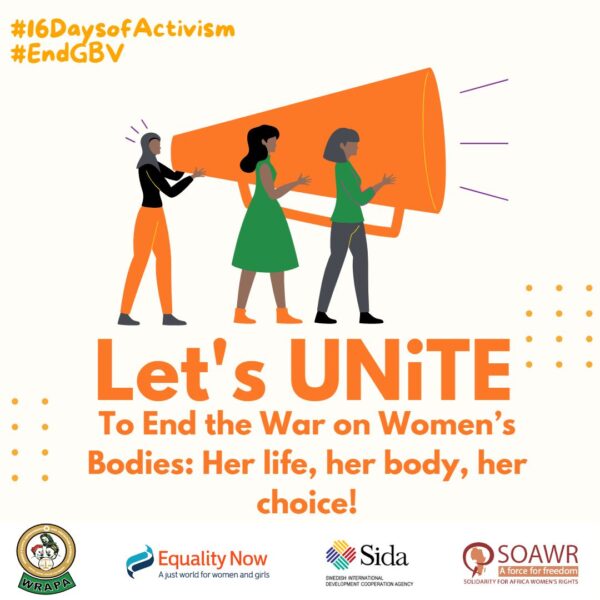
To mitigate these issues affecting Women and Girls, WRAPA in partnership with SOAWR West African members where BAOBAB for Women’s Human Rights with funding from Equality Now takes the lead, kicks off the 16 days of Activism with a campaign themed “Let’s Unite to End the War on Women’s Bodies: Her life, her body, her choice” to Promote Knowledge of the Maputo Protocol for the Protection of Women’s Rights in Ghana, Liberia and Nigeria.

The campaign is to raise public awareness and enhance the visibility of, and dialogue on the utilization to end Sexual and Gender Based Violence (SGBV) and promote Sexual and Reproductive Health Rights (SRHR) of the Maputo Protocol (Articles 4 and 14).

We are calling on all well meaning Nigerians in relevant quarters to support the campaign via our social media channels @wrapang with the hashtag #herbodyrights to participate in the campaign and join voices in creating an enabling society for Women and Girls.

WRAPA Nigeria

Recruitment for a Mapping Consultant


EU/UN WOMEN SPOTLIGHT INITIATIVE PROJECT

Negotiating & Strengthening SGBV Protection for Women’s Rights Advocates /Marginalized Groups in FCT, Adamawa and Sokoto States

Background

The issue of gender based violence affects hundreds of millions of people around the world. This has peculiar
implications for people with marginalized racial, ethnic, class, indigenous, or disabled status. “Violence against
women and girls is among the most widespread and a devastating human rights violation in the world, but much
of it is often unreported due to norms and practices that further entrench gender inequality through the culture
of impunity, public shaming, and forced silence. Global statistics show that one in four women will experience a
form of violence in her lifetime; yet women’s rights issues remain hugely underfunded” (UN Women, 2019).
The Nigerian Government’s response has included efforts to improve its institutional and policy framework,
which include the Violence against Person Prohibition (VAPP) Act, enacted at the national level in 2015 passed
in 32 States, the National Policy on the Elimination of FGM/C, the National Strategy to End Child Marriage, a
Road Map and National Priority Actions to End Violence Against Children (VAC) which have been adopted and
are being supported for implementation as well as several policies and frameworks for a conducive environment
for women and girls’ access to quality sexual and reproductive health and rights (SRHR) information and
services. Civil society remains a key important constituency, working to hold the government accountable to
deliver on rights protection. However, despite the existence of a strong feminist movement, the potential of civil
society and women groups to advance women’s rights, including SRHR, has been insufficiently tapped to date
due to limited coordination and capacity gaps.
Women’s Rights Advancement and Protection Alternative (WRAPA) is rights based non-profit charitable
organization promoting and influencing the enforcement of women’s human rights, the elimination of repugnant
practices, violence against women, and enhancement of their living standards. WRAPA as a Spotlight
implementing partner (IP) contributes to the delivery of SI ultimate goal under pillar 6.(Women’s movement)
“Negotiating & Strengthening SGBV Protection For Women’s Rights Advocates /Marginalized Groups In Adamawa, Sokoto States and the FCT”.
WRAPA is engaging a Consultant, who is to update an existing mapped list and further conduct a Mapping
of relevant organizations/entities working on GEWE and VAWG/SGBV/HP/SRHR in six Local Government
Area Councils in FCT,six Local Government Areas in each state of Sokoto and Adamawa.

Position Title: Mapping Consultant.
Contract Type: Individual Consultancy
Duty Station: Abuja (In person and virtual trainings/engagements in Abuja,
Adamawa & Sokoto)
Duration of Assignment: July 2022 (11) working days
Line Manager: Project Coordinator

1. Recruitment Objective
WRAPA is engaging a Consultant, who is to update existing mapped list and further conduct a Mapping of
relevant organizations/entities working on GEWE and VAWG/SGBV/HP/SRHR in FCT, Sokoto and Adamawa
States.

2. Responsibilities & Task

2.1 Responsibilities

The Consultant shall Update Phase 1 Mapping from 60 per state to 1000 per states. This will be addressed
through engaging with WRAPA strategic deliberate mapping of 10 per states coalition/network lead. And adopt
existing structures and the stakeholders disaggregation model towards achieving linkage of CSOs representing
youth and other groups facing multiple and intersecting forms of discrimination (Women LHIV, Widows,
disability groups, etc.) and integrate them with coalitions, networks of women’s rights groups as well as civil
society working on ending VAWG to jointly advocate on EVAWG in FCT, Adamawa and Sokoto States.
This aligns with a deliberate practice for phase II adopted by the UN for promoting inclusivity of the most
vulnerable groups such as key populations, people living with disabilities, people living with HIV/AIDS, youth
groups etc. Hence, mapping will serve to improve equitable representation of all key stakeholders in planned
program interventions.
And;
a) Demonstrate a thorough and in-depth understanding of project scope and specifics i.e. technical
content, timeframes, financials, reporting and engagement protocols;
b) Comply with all obligations deriving from this MoU, as well as WRAPA guidelines, to support
coordination, management, and implementation of the Project;
c) Ensure a clear communication of the project intent and focus to engender broad buy-in of key state
and non-state actors for project efficiency and sustainability;
d) Liaise and work with FCT,, Adamawa and Sokoto States Project Officer, Survey Coordinators,
Consultants and other stakeholders;
e) Ensure project visibility & issue amplification through strategic stakeholder interface, and
networking;
f) Comply with all EU UN/SI project objectives, plans, delivery guidelines outputs and results, and
notify WRAPA of any issues or challenges;
g) Other duties as may be directed by Project Coordinator

2.2 Tasks

a) Identification and mapping of relevant organizations/entities working on GEWE and
VAWG/SGBV/HP/SRHR in six (6) Area Councils in FCT,six(6) Local Government Areas in each
state of Sokoto and Adamawa,.
b) To find, build and solidify Women Rights & youth Organizations who are in these states and working
to reduce VAW
c) Identify, appoint and train data collectors and Survey Coordinators
d) Coordinate and supervise quality of data submissions from Data Survey Coordinators.
e) Coordination, monitoring & reportage in FCT, Adamawa & Sokoto States
f) Submit harmonized updated Mapping report of FCT Adamawa and Sokoto States.

3. Expected Deliverables:

a. Comprehensive and detailed mapping of relevant organizations/entities working on GEWE and
VAWG/SGBV/HP/SRHR in six (6) Area Councils in FCT,six Local Government Areas in each
state of Sokoto and Adamawa,.
b. Enhancing strategic Programme Planning process for the engagement of relevant Partner
stakeholders for delivery of SI Project.

How to Apply: Send CV and Cover Letter to wraparecruitment@gmail.com

Use the job title as the subject of the email.
Deadline: Wednesday 20th July, 2022.

WRAPA urges more women to engage in technology to advance women’s participation in future elections

As we may know every March 8 is set aside as International Women’s Day. A day specially dedicated to celebrating women and their achievements around the world as well as raising awareness on the challenges being faced by women and determining ways of achieving gender equality.

This year’s celebration is themed “DigitALL: Innovation and technology for gender equality,” which highlights the role of innovative technology in promoting gender equality and meeting the health and developmental needs of women and girls, especially politics in the Nigerian context.

Gender inequality and discrimination in Nigeria affects women’s participation in elections as we’ve witnessed over the years, either as a voter or candidate, women frequently face social, physical, psychological, economic, and cultural obstacles that hinder the full exercise of their participation rights and they often suffer from discrimination and violence.

As at date, the number of females that won the Senate is 3 and the number that won the House of Representatives is 14 as opposed to 8 and 11 in the 2019 general elections respectively, while we secured gains in the House of Representatives the number of female Senators is relatively low.
Women encounter bias in politics which legitimizes the dominance of men. The political environment is hostile to women, negatively impacting their potential, retention, and progress. This is quite unsettling!

Notwithstanding, we cannot ignore the impact of the digital world and how it affects women globally. WRAPA Nigeria stands in solidarity with numerous CSOs, CBOs, and WROs who have dedicated this year’s International Women’s Day to achieving gender equality in the context of digitalization.

Women are more likely to improve their political participation through the great use of the digital world. We have witnessed how powerful the digital world can be in promoting advocacy for a just cause and one of them being women’s participation in politics. Therefore we are encouraging women to learn and relearn the usage of technology, adopting all its professional ethics to promote women’s participation in future elections.

Quite a number of women participated to be elected in the 2023 General Elections, but only a few knew who and what political platform they campaigned under and the reason for their lack of popularity in the political space is that the digital platforms available to popularize them were not properly or even used.

Today, WRAPA Nigeria calls on all institutions and people, especially women to break the digital gap within the shortest time possible with concerted efforts and voices to embrace the digital world and adopt its safe practices, innovation, and technology for gender equality.

We hope that by the next elections, there will be a significant number of women elected into political offices. Until then, let’s go DigitALL!

Gender & Affirmative Action Issue-Based Project (GAA-IBP)


BACKGROUND

Gender Affirmative Action (GAA) is a platform of women-focused government and non-government organizations supported by DFID through its Coalitions for Change (C4C) Programme (July 2008 – Sept 2011).

GAA is overseen by a Steering Committee comprised of 8 institutions from both the demand (civil society demands for change) and supply side (government supplies the change).

GAA employs an Issue based approach that engenders interventions constructed around issues and felt needs with government and its agencies, CSOs, communities, the media, the organized private sector and development partners working together to achieve specified results and impact. It engenders strengthened commitment, depth of impact and sustainability
Furthermore, Women’s low representation and participation in political parties and their governance structures are the stark realities of Nigeria’s democracy today. Global and local organizations and individual activists continue to work conscientiously to reverse this trend. Advocacy and social mobilization have resulted in the current President’s declaration of commitment to implement 35% affirmative action for women in appointive positions in Nigeria as recommended by the National Gender Policy. Concerted efforts are needed to identify suitably qualified women to occupy these positions and to hold the President accountable for this promise.
Gender and Affirmative Action (GAA) is an issue-based project supported by DfID through the Coalitions for Change (C4C) programme and works to advance gender equity through affirmative action. The issue-based approach is a unique programming method that brings a core of committed stakeholders from different sectors together to work collaboratively on a single issue at a time. GAA is overseen by a steering committee made up of demand and supply side organizations working collaboratively to create spaces for women in politics and the socio-economic sphere. Currently, the IBP’s work is designed to capture a singular objective – Quantity and quality of women in socio economic and political sphere increased. The project was designed to deliver three key results as follows:

  • Gender Technical Unit serving as a resource to Parliamentarians, 5 National Assembly committees (Senate and House Committees on Women Affairs, House Committee on Human Rights, Senate Committee on Judiciary, Human Rights and Legal Matters , House Committee on Women in Parliament and House Committee on Rules and Business), Federal Ministry of Women Affairs, and Civil Society working on Affirmative Action.
  • Increased numbers of political parties adopting and complying with affirmative action mechanisms.
  • Lessons and learning from Issue-Based Approach (IBA) process and results documented and disseminated.

In June/July 2011, GAA commissioned a performance survey to highlight its key achievements, challenges and lessons learned using the issue-based approach to programming. The review methodology included:

  • Desk review of selected documents
  • In-depth interviews with selected stakeholders
  • Scanning of activity reports to identify clear and verifiable progress for all indicators in the IBP’s results framework.
  • Validation of findings through stakeholder consultation.

Objective of the project

  •  To increase the quality and quantity of women in Nigeria’s socio-economic and political sphere

OUTCOMES/IMPACT OF THE PROJECT

  •  A Gender Technical Unit has been established within the premises of the National Assembly (first of its kind in Africa) and currently serves as a resource to a wide range of stakeholders within the Assembly and within Civil Society ranks (result area 1).
  • GAA, through its advocacy and lobbying efforts prior to the 2011 elections has succeeded in influencing political parties with clear proposals to acknowledge and take specific actions that concretely open up the political space for women’s participation on the one hand, and has built women’s capacity on the other hand to claim these spaces by participating meaningfully in politics.
  • GAA and its partners continue to promote and model the IBA as a veritable programming approach that enhances deeper and more sustainable achievements due to horizontal and vertical institutional links and contributions.
  • GAA is currently recognized and patronized by both demand and supply side organizations as a technical resource on gender equality and women empowerment issues.
  • GAA has succeeded in bringing high level visibility to women’s issues in influential circles.
  • GAA’s work has strengthened the nexus between civil society and government. The mutual suspicion that existed between CSOs and government has given way to partnership and collaboration.
  • GAA has given visibility and meaning to Affirmative Action. This has fostered buy–in of key stakeholders.
  • It is widely believed that GAA’s work highly influenced both the work of the Nigerian First Lady’s Women for Change Initiative which extensively mobilized energy and attention on 35% AA throughout the country using the campaign platform for the 2011 elections leading to commitments by State Governors and later the President’s declaration of support for 35% affirmative action in appointive posts.
  • GAA has packaged lobbying as a pragmatic, measurable strategy. In collaboration with the Federal Ministry of Women Affairs and Social Development (FMWASD), an existing mechanism of the latter was transformed into a substantive lobby group and deployed before the 2011 elections to elicit commitment from political parties to support women’s candidacy.
  • GAA has brought Women with Disabilities on board as partners. This will further give voice to their hitherto neglected issues.
  • A gendered lesson learning and sharing space for expanding women’s participation in policy and politics created
  • A structured process created for engaging with strategic stakeholders towards promoting 35% Affirmative Action for Women in line with the National Gender Policy
  • Mechanism to enhance the executive and legislative processes of domesticating CEDAW, AU Protocol in place.

Subscribe to our
Newsletter

Contact

The organisation seeks to advance and protect the rights of women as provided by national laws and policies, regional and international treaties

No 34 Ekikunam Street Beside NUJ Secretariat, Utako-Abuja, Nigeria

About Us

Media

Get Involved

CALL: +234-818-869-9961

Contact

automaty bez registrace